

Your daughter sends you a Carlsbad listing. It’s close enough that you could pick up the grandkids from school on Thursdays. You’ve offered to help with the down payment. Then she sees the monthly payment and says, “Maybe we should wait until rates come down.”
She may be right. But before you rule out the house, I’d ask two questions. What monthly payment would she feel comfortable making? And what would this seller be willing to do to get the home sold?
If the house has been sitting and yours is the only offer, you may have room to ask the seller to cover part of the first two years of payments. If rates fall and three other buyers want the same house, that conversation could go differently. Here’s how I’d put numbers to both possibilities.
What would your down payment gift actually change?
Take a $1.5 million North County home. Suppose your daughter has $200,000 for the down payment, separate from her closing costs and emergency savings. A $100,000 gift from you brings her to $300,000 down, or 20%. Her mortgage drops from $1.3 million to $1.2 million.
On a 30-year fixed loan at an illustrative 7.25%, borrowing $100,000 less saves her about $682 a month in principal and interest. That benefit lasts as long as she keeps the loan. If she uses your gift to raise her offer by $100,000 instead, she borrows just as much as before.
Start with the payment she can carry after taxes, insurance, any HOA dues and upkeep. Ask her lender to price the same house with and without your proposed gift. Before you move money, tell the lender whether you expect to be repaid. A gift and a family loan are handled differently. More on gifts and family loans in San Diego
What if the seller helped, too?
On that same $1.5 million purchase, you could ask the seller to fund a 2-1 buydown. The seller puts money into an account at closing. Each month for the first two years, that account covers part of the mortgage payment. The fixed rate on the loan stays at 7.25%.
Here’s what your daughter would pay in the example, with your gift already included.
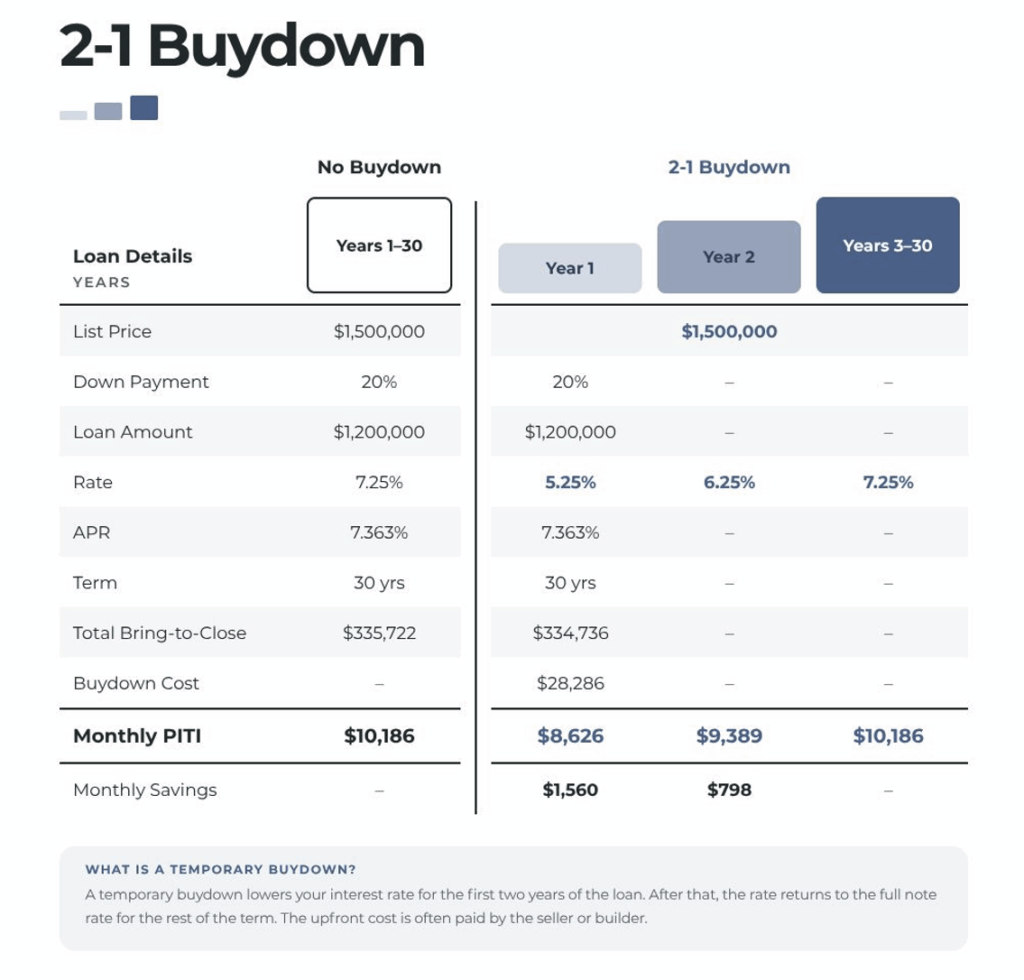

The illustration uses a $1.2 million, 30-year fixed loan (7.363% APR). Payments include estimated principal, interest, property taxes and homeowners insurance. Taxes and insurance can change. Your lender can quote current rates and costs.
The seller credit in this example is $28,286. Without it, her estimated payment starts at $10,186. With it, she keeps roughly $1,560 a month in her pocket the first year. That could help her rebuild savings after closing.
Would $10,186 still fit her budget if she never refinanced? If it would, the seller credit is worth discussing. If it wouldn’t, I’d look at a lower purchase price. Ask the lender to confirm which credits the loan allows, how the buyer qualifies and what the same seller dollars would do as a price reduction. Fannie Mae’s guide to temporary buydowns
Would waiting a year put your family ahead?
Pick a home you’d actually buy and use the lender’s quote for that address. Then try the Buy Now vs. Later calculator with two different versions of next year.
- Give waiting a fair shot. Assume rates fall one percentage point and the home price stays flat. Include the extra down payment your child could save over the year.
- See what would change the answer. Keep that same lower rate, but try 3% appreciation. On a $1.5 million home, that puts next year’s price at $1,545,000. Then consider what happens if competing offers mean the seller will no longer cover the $28,286 buydown.


Those are assumptions you can change. If you think prices in your neighborhood could fall, run that version, too. Compare the cash you’d need at closing and the full monthly payment in each case. You may find that waiting works well even with a modest price increase. Or you may discover that the seller’s willingness to negotiate is what makes today’s house work.
Compare buying now with waiting using your own numbers
What if their current rental is a good deal?
Use the rent your child actually pays and the number of years they expect to stay. A family paying below-market rent in Encinitas with two years before a possible job move has a different decision from one hoping to stay through elementary school. Compare the rent with the full cost of owning, including HOA dues, maintenance and the cost of selling when they move.


Run the Rent vs. Buy calculator for your family
Send me the listing you’re discussing
A calculator can show you what a $28,286 credit would do. What it can’t tell you is whether the owner of that Carlsbad house would agree to one. That’s where I can help. I’ll look at recent nearby sales, check for price reductions and find out whether there are other offers. Then we can talk through what I’d ask the seller for and what your lender should price before you make a decision.
Call or text me at 858-630-8997 with the listing and the monthly payment your family wants to stay under. If you’re still choosing between neighborhoods, send me the two you have in mind. Contact Jeff at LuxeAlly
Jeff Toth | Founding Partner, LuxeAlly Real Estate | California DRE #01969791
Frequently Asked Questions
Pick one home they’d actually buy and compare two scenarios. First, use today’s asking price and a rate quoted by their lender. Then try the same home a year from now at a lower rate. Start with a flat price, then see what happens if the price rises or falls. If more buyers are competing next year, would the numbers still work without a seller credit? If the full payment today would stretch their budget, waiting and saving more may make sense. Compare buying now vs. waiting
The seller sets aside money at closing to cover part of the buyer’s mortgage payments for two years. The buyer pays as if the interest rate were two percentage points lower in year one and one point lower in year two. The loan’s fixed rate stays the same, and the buyer makes the full payment starting in year three.
Yes, if the lender approves and the seller agrees. Your gift reduces how much your child borrows. The seller’s credit lowers what your child pays during the first two years.
With the same down payment, a price cut lowers the payment for the life of the loan. A buydown offers more monthly relief upfront. Ask Jeff Toth to compare both using the same dollar amount from the seller using the rate buydown calculator.


