

San Diego FAQ: the most common FinCEN questions for 2026 closings
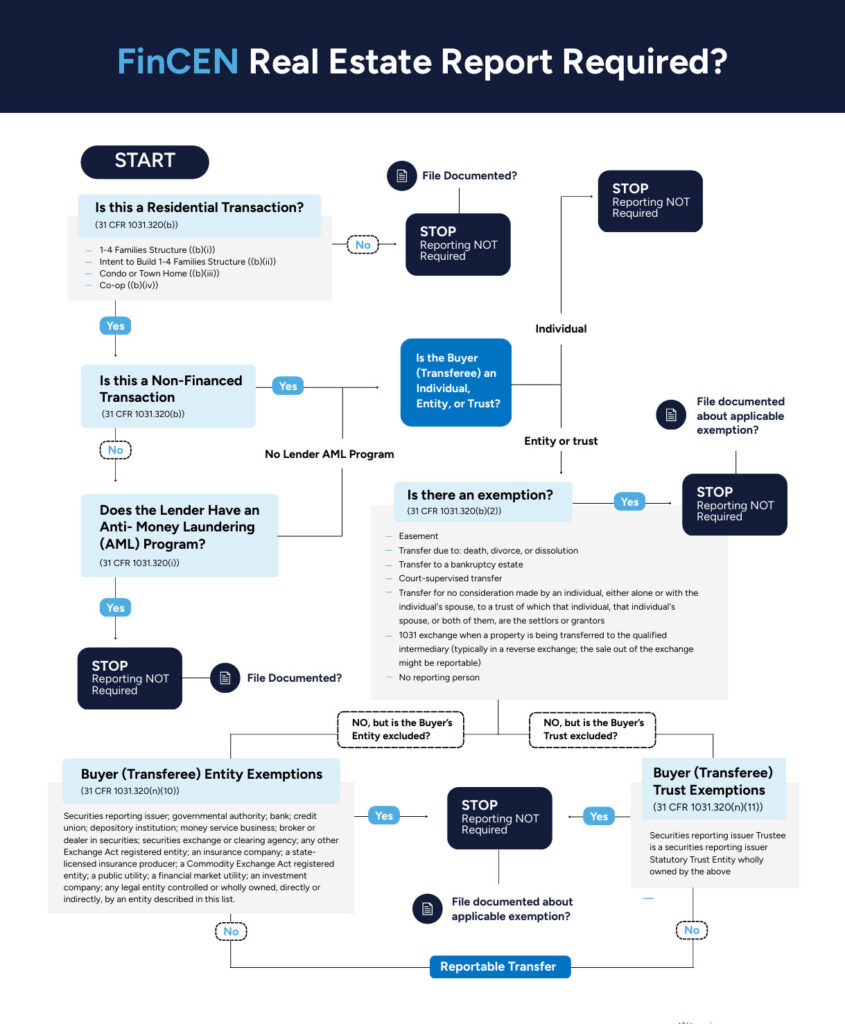
What FinCEN’s new Residential Real Estate Rule does
FinCEN’s published guidance explains that beginning March 1, 2026, certain ownership transfers in residential real estate must be reported by certain real estate professionals involved in the settlement/closing process to the U.S. Treasury’s Financial Crimes Enforcement Network (FinCEN). (FinCEN, Fact Sheet: Residential Real Estate Reporting Requirement, p. 1)
FinCEN’s consumer-facing guidance also emphasizes a key point for your readers: homebuyers are not required to file reports; instead, reporting is handled by the professionals involved in closing/settlement (often the closing/settlement agent). (FinCEN, Fact Sheet: Residential Real Estate Reporting Requirement, p. 1)
Is your San Diego transaction reportable?
Residential property? The flowchart lists common covered categories: 1–4 family residential structures, condos/townhomes, co-ops, and land intended for building a 1–4 family structure, with a citation to the rule’s residential real property definition.
Non-financed? FinCEN defines a “non-financed transfer” as one that does not involve an extension of credit to all transferees that is both secured by the property and extended by a financial institution subject to AML program requirements and SAR obligations. FinCEN further clarifies that if a lender does not have AML/SAR obligations, financing from that lender is treated as non-financed for purposes of this rule if other reportability criteria are met.
Buyer type matters: The flowchart stops reporting when the buyer is an individual, and continues the analysis when the buyer is an entity or trust—matching FinCEN’s summary that the requirement is targeted to transfers to qualifying legal entities or trusts.
What information may be collected for the Real Estate Report
FinCEN’s official Real Estate Report form (Release Date 12/01/2025) includes fields and role checkboxes for people connected to the transferee, including “Beneficial Owner” and “Signing Individual” and collects identifying information such as name, date of birth (for beneficial owners/signing individuals), and residential address for those individuals. (FinCEN, Real Estate Report (form), OMB No. 1506-0080, Release Date 12/01/2025)
Who must report vs exempt
FinCEN’s fact sheet is explicit that closing/settlement professionals are the ones required to file, and that homebuyers do not file. The table below is written for a typical San Diego transaction workflow while staying aligned with what FinCEN states in its consumer guidance.
| party | must report? (yes/no) | notes |
|---|---|---|
| Escrow / closing / settlement agent (the closing professional) | Yes | FinCEN states real estate professionals involved in settlement/closing (such as closing or settlement agents) are required to file reports for covered transfers. (FinCEN, Fact Sheet: Residential Real Estate Reporting Requirement, p. 1) |
| Title/settlement team (in a closing/settlement role) | Yes (often, via the closing/settlement function) | The reporting obligation sits with the settlement/closing professional function for a covered transfer; in practice this is commonly handled within escrow/title closing operations. (FinCEN, Fact Sheet: Residential Real Estate Reporting Requirement, p. 1) |
| Buyer (individual) | No | FinCEN notes there is no reporting requirement when the homebuyer is an individual, and buyers do not file reports themselves. (FinCEN, Fact Sheet: Residential Real Estate Reporting Requirement, p. 1; Attached image: flowchart, buyer type stop) |
| Buyer (LLC/corporation/partnership/estate/association) | No (but must cooperate) | The transfer may be reportable if it’s non-financed and no exception applies; the buyer may be asked for information needed for the Real Estate Report (including beneficial owner fields on the form). (FinCEN, Fact Sheet, p. 1; FinCEN, Real Estate Report form, Release Date 12/01/2025) |
| Buyer (trust) | No (but must cooperate) | Same practical expectation as entity buyers if the transfer is non-financed and no exception applies; the report includes “beneficial owner” roles and identifying info fields. (FinCEN, Real Estate Report form, Release Date 12/01/2025) |
| Seller | No | FinCEN’s consumer guidance focuses reporting duty on closing/settlement professionals, not the transferor. (FinCEN, Fact Sheet: Residential Real Estate Reporting Requirement, p. 1) |
| Real estate agent (buyer’s or listing agent) | No | FinCEN’s consumer guidance states reporting is done by settlement/closing professionals; agents should treat their role as coordination and education, not filing. (FinCEN, Fact Sheet: Residential Real Estate Reporting Requirement, p. 1) |
| Bank / “similar financial institution” providing financing (mortgage) | No (and may remove the deal from coverage) | FinCEN states there’s no reporting requirement when the transfer is financed (e.g., with a mortgage), and defines non-financed by reference to lenders with AML/SAR obligations. (FinCEN, Fact Sheet, p. 1; FinCEN, Quick Reference Guide, p. 1) |
| Private lender without AML/SAR obligations | No (but financing may still be treated as “non-financed”) | FinCEN states financing by a lender without AML/SAR obligations is treated under the rule as non-financed if other reportability criteria are met. (FinCEN, Quick Reference Guide: Residential Real Estate Reporting, p. 1) |
Practical steps for San Diego buyers and sellers
Buyers in San Diego
If you’re buying as an individual with a standard mortgage, you can usually expect less change—FinCEN states financed transfers (e.g., mortgages) and individual buyers are not the targeted reporting scenario in the fact sheet’s examples. (FinCEN, Fact Sheet: Residential Real Estate Reporting Requirement, p. 1)
If you’re buying as an LLC or trust, or buying all-cash, do this early (before you’re within days of closing):
- Tell your agent and escrow/title how you’re taking title (individual vs LLC vs trust). (FinCEN, Fact Sheet, p. 1; Attached image: flowchart, buyer-type branch)
- Confirm whether your transaction is “non-financed” under FinCEN’s definition—especially if you’re using private/hard-money/seller financing, because FinCEN treats some non-bank financing as “non-financed.” (FinCEN, Quick Reference Guide, p. 1)
- Be prepared to provide the information categories that appear on FinCEN’s Real Estate Report form, including beneficial owner/signing individual identifying details when applicable. (FinCEN, Real Estate Report form, Release Date 12/01/2025)
Sellers
Sellers generally won’t file anything, but you can reduce friction:
- Ask early: “Is the buyer an individual, entity, or trust?” (FinCEN, Fact Sheet, p. 1; Attached image: flowchart, buyer-type branch)
- If the offer is all-cash or a gift structure, flag it to escrow/title so they can confirm whether the transfer is treated as non-financed for reporting purposes. (FinCEN, Fact Sheet, p. 1)
FAQ for San Diego buyers, sellers, and agents
Q&A
Does this rule start in 2026?
Yes. FinCEN’s fact sheet and quick reference guide both state the reporting requirement begins March 1, 2026. (FinCEN, Fact Sheet, p. 1; FinCEN, Quick Reference Guide, p. 1)
Do San Diego buyers or sellers file the report themselves?
Usually no. FinCEN states settlement/closing professionals (such as closing/settlement agents) file the report, and homebuyers are not required to file. (FinCEN, Fact Sheet, p. 1)
I’m buying with a normal mortgage—does FinCEN reporting apply?
FinCEN says there is no reporting requirement when the transfer is financed (such as with a mortgage). (FinCEN, Fact Sheet: Residential Real Estate Reporting Requirement, p. 1)
What does “non-financed” mean under FinCEN’s rule?
FinCEN defines non-financed as lacking qualifying credit to all transferees that is secured by the property and extended by a lender subject to AML program and SAR obligations. (FinCEN, Quick Reference Guide, p. 1)
What if I’m using private financing, hard money, or seller financing?
FinCEN states that financing by a lender without AML/SAR obligations is treated under the rule as non-financed if other reportability criteria are met. (FinCEN, Quick Reference Guide: Residential Real Estate Reporting, p. 1)
If the buyer is an LLC or trust, what may escrow/title ask for?
FinCEN’s Real Estate Report form includes fields and role choices that explicitly include beneficial owners and signing individuals, along with identifying information such as date of birth and residential address for those roles. (FinCEN, Real Estate Report form, Release Date 12/01/2025)
Are all residential properties covered?
The attached flowchart’s “residential transaction” box lists typical covered residential categories, including 1–4 family structures, condos/townhomes, co-ops, and land intended to build 1–4 family housing, and cites the relevant rule section.
Are there exceptions for death, divorce, bankruptcy, or a court order?
The attached flowchart lists common exceptions including transfers due to death, divorce/dissolution, bankruptcy estate transfers, and court-supervised transfers, and cites the rule’s exceptions section.
Will my information be public?
FinCEN’s fact sheet states reports will be stored in a secure, non-public database available only to authorized users.
When is the Real Estate Report due after closing?
FinCEN’s quick reference guide states the deadline is the later of (1) the last day of the month after the closing month, or (2) 30 calendar days after closing. (FinCEN, Quick Reference Guide: Residential Real Estate Reporting, p. 1)